


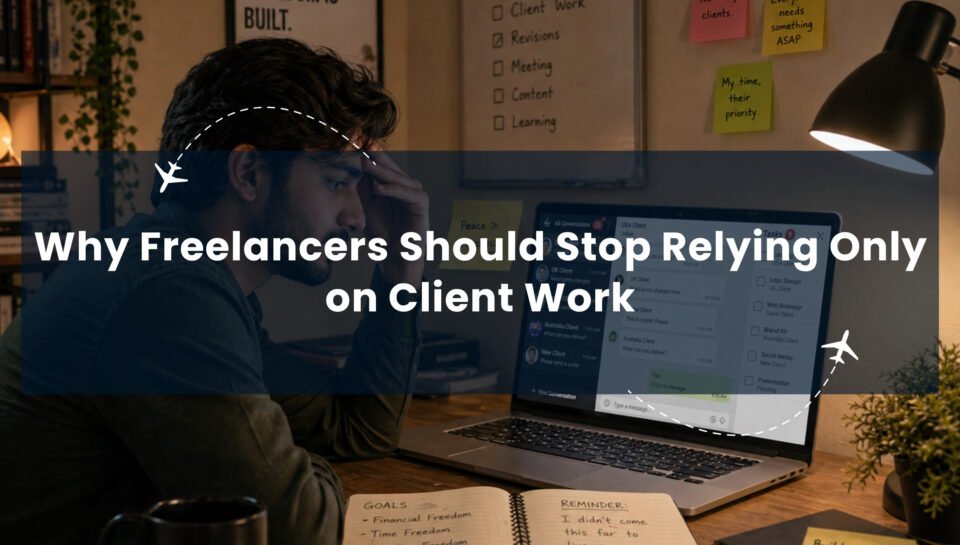

Why Freelancers Should Stop Relying Only on Client Work
What Freelancing Really Looks Like Today
Freelancing in Pakistan has created new earning opportunities for thousands of people. Designers, writers, developers, and marketers now work independently and connect with clients worldwide. This shift has allowed many individuals to step away from traditional jobs and build careers on their own terms. The flexibility and control make freelancing feel like the ideal path, especially in the early stages.
At the beginning, everything seems simple. You find clients, complete projects, and get paid. Over time, this routine starts to feel stable. Many freelancers begin to believe they have full control over their income because they decide how much work to take on. However, a different reality slowly becomes clear as experience grows.
Income does not come from a system. It comes from clients.
Each payment depends on a project. Each project depends on a client. Each month depends on how much work is available. This pattern may not feel like a problem at first, but it creates a dependency that becomes more noticeable with time. Even during busy periods, a question often remains in the background: what happens next?
Where Things Begin to Feel Unstable
Freelancing works well until consistency becomes important. Early success usually comes from completing projects and building a reputation. Growth feels possible because new clients continue to appear. At some point, however, the unpredictability starts to stand out.
Clients control the flow of work. They decide when they need services, how much they want to pay, and whether they continue working with the same freelancer. Because of this, income often depends on decisions made by others. Skill and effort still matter, but they do not guarantee stability.
Some months bring strong results, while others feel slow. A reliable client may suddenly disappear without warning. Changes in the market can affect demand, and competition can impact pricing. These shifts create uncertainty that is difficult to manage.
As a result, freelancers rarely feel fully secure. Time gets divided between doing the work and searching for the next opportunity. Finishing a project does not bring relief because the next one must be found quickly. This continuous cycle makes it harder to step back and think long term.
What Most Freelancers Overlook
Working with clients is not the problem. In fact, clients provide valuable opportunities and help freelancers build experience. The real issue comes from relying on them as the only source of income. When all earnings come from client work, there is no fallback option.
Many freelancers try to fix this by improving their skills. They learn new tools, refine their services, and aim to attract higher-paying clients. Although this approach helps increase income, it does not change the structure behind it. Earnings still depend on someone else offering work.
This creates a hidden limitation. Growth happens within the same system, but the system itself remains unchanged. Even experienced freelancers can feel stuck because their income still relies on external demand. Progress becomes incremental instead of transformational.
Another important detail often gets ignored. More clients do not always solve the problem. Managing multiple projects can increase workload without improving stability. In some cases, it adds more pressure instead of reducing it.
A More Flexible Way to Think About Income
A different approach begins by looking beyond client work. Freelancing can remain the foundation, but it does not have to be the only way to earn. Expanding income sources allows freelancers to reduce dependency and create more control over time.
This shift focuses on building income that is not tied directly to hours worked. Instead of relying only on one-time projects, freelancers can explore ways to create value that continues over time. This could involve repeat interactions, ongoing demand, or systems that generate income without constant effort.
Thinking in this direction changes priorities. Instead of chasing every new project, attention moves toward creating something sustainable. This reduces pressure and opens the door to more stable growth.
The goal is not to replace freelancing. The goal is to strengthen it by adding another layer of income.
Why This Shift Is Becoming Necessary
The freelance market continues to grow rapidly. More individuals enter the space each year, offering similar services across platforms. Increased competition affects pricing and makes it harder to stand out. Clients now have more choices, which changes how they select freelancers.
Under these conditions, relying only on client work becomes more challenging. Income can fluctuate more frequently, and securing long-term projects becomes less predictable. Freelancers who depend entirely on projects may find it harder to maintain consistency.
Those who diversify their income approach the situation differently. They are not forced to accept every project because they have alternatives. This flexibility allows them to focus on better opportunities instead of short-term survival.
Over time, this difference becomes significant. One approach creates constant pressure, while the other creates space for growth.
How Freelancers Can Start Shifting Their Approach
Change does not require a complete reset. A gradual shift works better and feels more manageable. The first step involves recognizing that relying only on client work has limits. Once that idea becomes clear, new possibilities start to appear.
Exploring different income models can help build awareness. Some industries operate through systems rather than direct effort. Others rely on transactions or repeat customers instead of one-time projects. Learning how these models work can provide useful insights.
Small experiments can make a big difference. Freelancers can start by testing new ideas alongside their existing work. This reduces risk while creating opportunities to learn. Over time, these small steps can develop into a reliable second income stream.
Consistency matters more than speed in this process. Gradual progress leads to stronger and more sustainable results.
This Is Where Control Starts to Shift
Freelancing gives you the ability to earn, but relying only on client work limits how much control you actually have. Real control begins when income no longer depends entirely on someone else’s decisions. Creating additional streams allows freelancers to move from uncertainty toward stability.
This shift does not come from working longer hours. It comes from building smarter structures. Instead of reacting to opportunities, freelancers begin to create them. Instead of chasing income, they start designing how it flows.
Growth becomes more intentional at this stage. Effort still matters, but it gets directed toward building something that lasts. Over time, this approach changes how freelancing feels. Pressure decreases, confidence increases, and decisions become more strategic.